
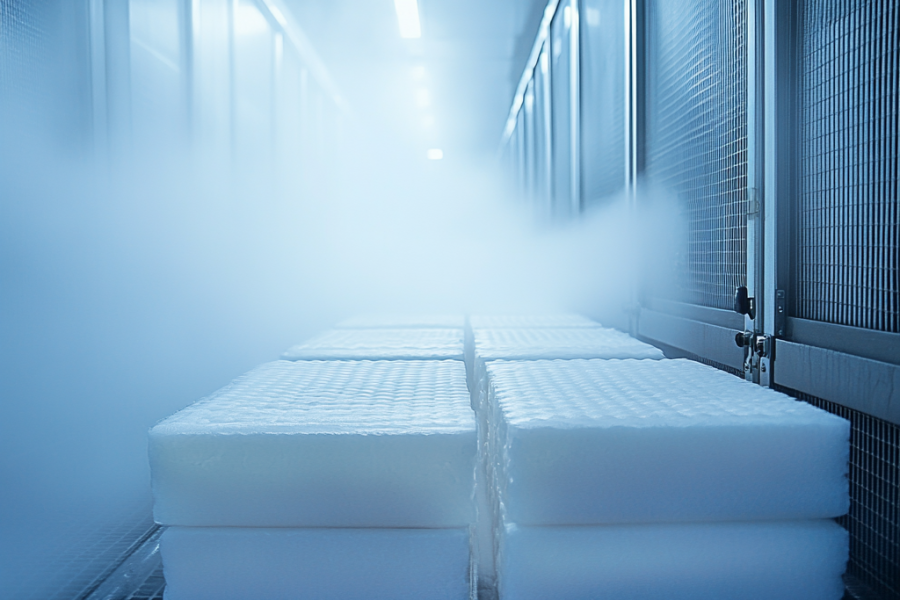
For high-volume commercial operations, dry ice is not a convenience item—it’s critical infrastructure. Food processors, medical labs, manufacturers, logistics providers, and industrial service companies all rely on consistent dry ice availability to keep operations running on schedule and within compliance requirements.
Yet many commercial users underestimate how fragile dry ice supply chains can be. Forecasting errors, storage limitations, inconsistent suppliers, and transportation delays routinely create operational disruptions that could have been avoided with better planning and the right supplier relationship.
This article breaks down the most common dry ice supply challenges faced by high-volume commercial users—and how companies avoid them by working with a trusted local producer like A+ Heler’s Dry Ice & CO₂.
Why Dry Ice Supply Becomes a Bottleneck at Scale
Dry ice behaves differently than most industrial materials. It sublimates continuously, loses mass over time, and cannot be stockpiled indefinitely. As volume increases, small inefficiencies in planning or sourcing quickly become major operational problems.
Commercial users often encounter supply issues when dry ice is treated as a commodity rather than a time-sensitive production input. At scale, success depends on:
- Accurate demand forecasting
- Proper on-site storage practices
- Reliable, predictable supply
- Fast response when needs change
Companies that rely on dry ice for daily operations—whether for food production, medical transport, or industrial cleaning—quickly learn that supply reliability matters as much as price.
This is where working with a local producer, not a reseller, becomes critical.
Forecasting Errors: The Most Common (and Costly) Mistake
One of the biggest challenges for high-volume users is forecasting demand accurately. Many organizations underestimate how variable dry ice usage can be based on seasonality, production volume, weather, and emergency needs.
Common forecasting issues include:
- Underestimating sublimation loss during transport or storage
- Failing to account for peak production cycles
- Not planning for emergency or unplanned usage
- Relying on static forecasts for dynamic operations
When forecasts fall short, the result is often production delays, compromised product integrity, or canceled jobs—especially for operations that depend on dry ice for shipping, sanitation, or temperature control.
A+ Heler’s works with commercial customers to plan realistic usage levels based on actual operational conditions, helping reduce surprises that lead to downtime. High-volume users often start these conversations by reviewing their core dry ice requirements and identifying where forecasting gaps exist.
Storage Limitations and Sublimation Loss
Even when forecasting is accurate, improper storage can undermine supply planning. Dry ice sublimates continuously, and storage conditions directly affect how quickly usable volume is lost.
High-volume commercial users often struggle with:
- Inadequate insulated storage
- Overstocking dry ice without accounting for sublimation
- Limited space for bulk quantities
- Poor handling practices that accelerate loss
These issues can turn what looks like sufficient supply into a shortage faster than expected. Facilities that rely on dry ice daily must balance having enough inventory on hand without over-ordering and wasting product.
This is especially important for companies using large quantities for recurring operations such as sanitation, shipping, or production support. Many address this challenge by shifting from sporadic purchasing to planned bulk dry ice supply with predictable pickup schedules.
Supplier Reliability: The Hidden Risk in Dry Ice Operations
Not all dry ice suppliers are equipped to support commercial-scale demand. Many businesses discover too late that their supplier:
- Relies on third-party production
- Has limited daily output capacity
- Cannot support same-day or short-notice needs
- Prioritizes retail or small-volume customers
For high-volume users, these limitations create risk. A missed delivery or delayed pickup can shut down entire operations.
A+ Heler’s operates as a local Madison-based producer, not a reseller. That distinction matters. Local production allows for fresher dry ice, reduced sublimation loss, and faster response when volumes need to increase unexpectedly.
Commercial customers often choose A+ Heler’s because their operations depend on supply certainty, not best-case assumptions.
Transportation and Timing Challenges
Dry ice does not tolerate long transit times well. The farther it travels, the more volume is lost before it ever reaches the customer. High-volume users relying on distant suppliers often experience inconsistent deliveries and unpredictable usable quantities.
Transportation challenges include:
- Volume loss during long-haul shipping
- Delays caused by weather or logistics disruptions
- Limited delivery windows that don’t align with operations
- Emergency needs that cannot wait for next-day fulfillment
Local production dramatically reduces these risks. A+ Heler’s supports commercial users with same-day availability and flexible pickup options, helping operations adapt when schedules change or emergencies arise.
This reliability is especially important for industries that operate outside standard business hours or experience seasonal surges in demand.
Industry-Wide Impact Across Commercial Users
While the specific use cases vary, dry ice supply challenges affect nearly every commercial sector that relies on it:
- Food processors depend on dry ice for sanitation support, temperature control, and uptime protection
- Medical and laboratory operations rely on dry ice to protect sample integrity and maintain compliance
- Logistics and shipping companies need predictable supply to prevent cold chain failures
- Industrial service providers require consistent volumes for time-sensitive jobs
In each case, supply failures translate directly into financial loss, compliance exposure, or customer dissatisfaction.
Many commercial users mitigate these risks by aligning dry ice supply with their broader operational strategy, often through a dedicated service partner experienced across multiple industries. Reviewing industry applications helps organizations understand how others manage similar challenges at scale.
Planning for Growth Without Supply Constraints
Another overlooked challenge is growth. As commercial operations expand, dry ice demand often increases faster than expected. Companies that don’t plan for this growth may outpace their supplier’s capacity.
Warning signs include:
- Increasing frequency of emergency orders
- Difficulty securing large volumes on short notice
- Rising waste due to rushed or inefficient storage
- Supplier hesitation when volume requests increase
A+ Heler’s supports scaling operations by working proactively with customers to anticipate growth and align production capacity accordingly. This approach allows commercial users to expand without worrying that dry ice availability will become a limiting factor.
For organizations planning new facilities, expanded production lines, or increased service offerings, early conversations with a local supplier can prevent costly bottlenecks later.
Safety, Compliance, and Operational Confidence
High-volume dry ice usage also introduces safety and compliance considerations. Improper handling, storage, or ventilation can create hazards in enclosed environments.
Commercial users should ensure:
- Proper employee training
- Adequate ventilation in storage and use areas
- Clear handling procedures
- Alignment with documented safety practices
A+ Heler’s supports regulated environments by maintaining clear standards and providing access to important operational resources, including safety information and certifications. This helps commercial customers integrate dry ice into their operations confidently and responsibly.
How High-Volume Users Avoid Dry Ice Supply Problems
Companies that consistently avoid dry ice disruptions tend to follow a few best practices:
- Work with a local producer, not a distant reseller
- Forecast usage realistically, including variability and emergencies
- Align storage capacity with actual operational needs
- Establish predictable pickup or supply schedules
- Maintain open communication with their supplier
A+ Heler’s builds long-term relationships with commercial customers by acting as a supply partner rather than a transactional vendor. This approach allows businesses to focus on operations instead of worrying about whether dry ice will be available when it’s needed most.
Talk to a Local Expert Before Problems Happen
Dry ice supply challenges rarely appear without warning—but they often escalate quickly when ignored. For high-volume commercial users, proactive planning and supplier selection are the difference between smooth operations and costly interruptions.
If dry ice plays a critical role in your business, the smartest next step is a conversation. Talking with a local expert at A+ Heler’s Dry Ice & CO₂ can help identify forecasting gaps, storage issues, and supply risks before they impact production.
Many commercial teams start by reviewing available dry ice services or requesting a discussion through Get a Quote to align supply with real-world operational demands.
